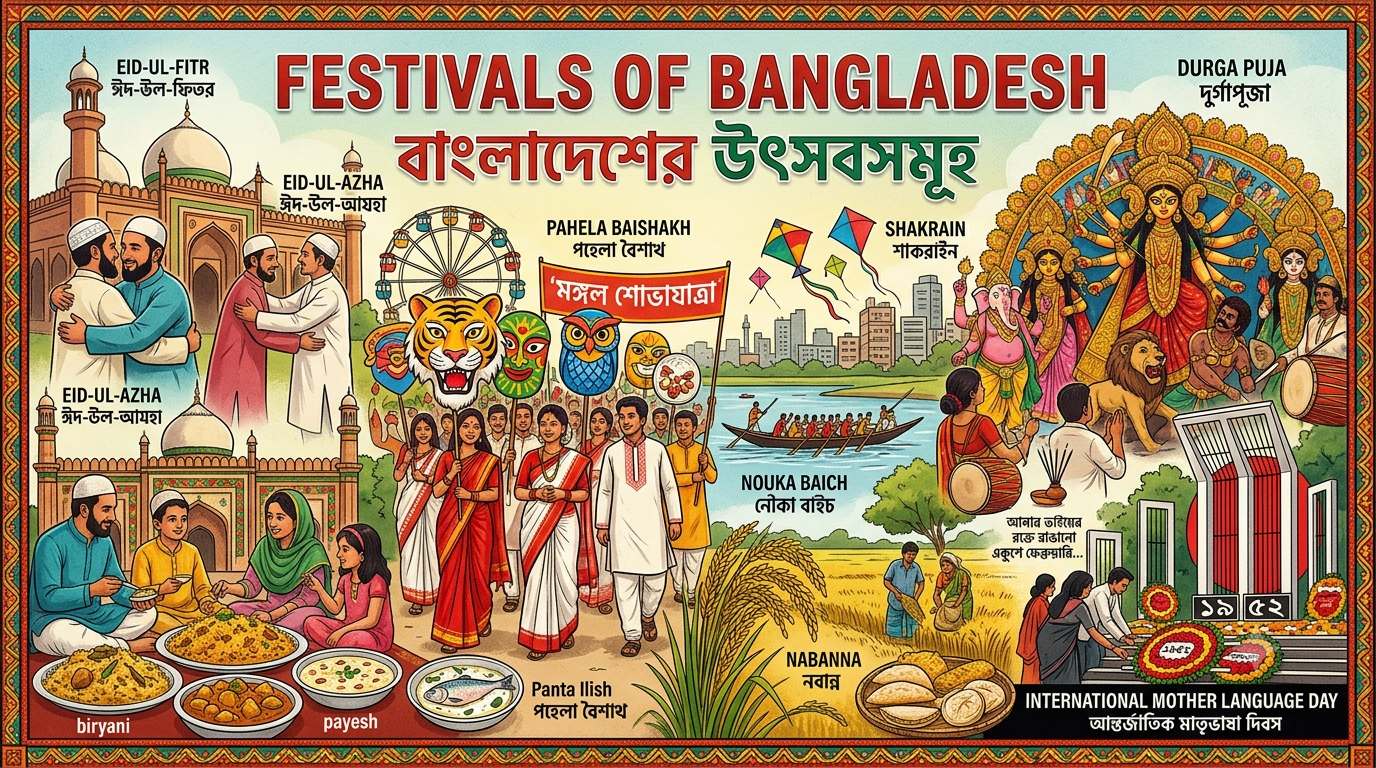
🌸 Festivals
Bangladesh’s vibrant cultural tapestry is best captured by the popular saying: "Tero Parbon-e Baro Mash" (thirteen festivals in twelve months). The country celebrates a rich diversity of secular, religious, and ethnic traditions with deep-rooted community spirit.
1. Pohela Boishakh (Bengali New Year)
- Significance: The first day of the Bengali calendar (April 14), celebrated as a universal secular festival across the country regardless of religion or ethnicity.
- Historical Origin: Traced back to the Mughal era, introduced during Emperor Akbar's reign to streamline agricultural tax collection (Fasli San).
- Key Customs:
- Mangal Shobhajatra: A colorful morning procession organized by students of the Faculty of Fine Arts, Dhaka University, featuring giant masks, motifs, and puppets symbolizing peace and unity. UNESCO declared it an Intangible Cultural Heritage of Humanity.
- Traditional Attire: Men wear Panjabi and women wear sarees, traditionally in red and white.
- Food Culture: Eating Panta Ilish (fermented rice with fried Hilsa fish, green chilies, and fried onions).
- Haal Khata: Business owners open new accounting ledgers, inviting long-time clients to clear past debts while offering them sweets.
2. Eid (Eid-ul-Fitr & Eid-ul-Adha)
- Significance: The two largest religious celebrations for the Muslim majority of Bangladesh.
- Eid-ul-Fitr:
- Marks the end of Ramadan (the month of fasting).
- Begins with special morning congregational prayers (Eid Jamaat) in large open grounds (Eidgahs) such as Sholakia or the National Eidgah.
- Families share festive dishes like Shemai (vermicelli dessert), Pulao, and Biryani.
- Adults distribute Eidi (cash gifts) to children, and Zakat-al-Fitr (charity) is paid to those in need.
- Eid-ul-Adha (Korbani Eid):
- Commemorates Prophet Ibrahim’s willingness to sacrifice his son in obedience to God.
- Involves the ritual sacrifice of livestock (cattle, goats, sheep).
- The meat is divided into three equal portions: one-third for the family, one-third for relatives/friends, and one-third distributed to the underprivileged.
3. Durga Puja
- Significance: The grandest religious and cultural festival for the Hindu community in Bangladesh, held in the autumn month of Ashwin (September/October).
- Religious Meaning: Honors Goddess Durga's victory over the demon Mahishasura, symbolizing the triumph of good over evil.
- Key Rituals & Sights:
- Five-Day Observance: Spans Shashthi, Saptami, Ashtami, Navami, and Dashami.
- Puja Mandaps: Thousands of ornate temporary structures (Pandals) house intricately crafted clay idols of Goddess Durga and her children (Lakshmi, Saraswati, Ganesha, and Kartikeya). Dhakeshwari National Temple in Dhaka is the central hub.
- Dhunuchi Naach: Energetic traditional dance performed to the rhythm of Dhak (drums) using incense burners.
- Bijoya Dashami: The final day marked by Sindoor Khela (married women smearing vermilion on each other) and the solemn Pratima Visarjan (immersion of idols in rivers).
4. Buddha Purnima (Vesak)
- Significance: The most sacred holiday for the Buddhist community, commemorating the birth, enlightenment, and passing (Parinirvana) of Gautama Buddha on the full moon day of Boishakh (May).
- Observances:
- Monastery Rituals: Devotees gather at Buddhist monasteries (such as Kamalapur Dharmarajika Buddha Vihara in Dhaka and various viharas in Chittagong, Cox's Bazar, and the Hill Tracts).
- Offerings & Charity: Lighting oil lamps, hoisting the Buddhist flag, chanting sacred scriptures (Sutras), and offering food and robes (Kathin Chibar Dan) to monks.
- Peace Rallies: Colorful processions promoting universal peace, non-violence, and harmony.
5. Christmas (Bara Din)
- Significance: Celebrated on December 25th as Bara Din ("The Big Day") by the Christian community in Bangladesh.
- Traditions & Festivities:
- Midnight Mass: Special prayer services held on Christmas Eve and Christmas morning in churches (e.g., St. Mary’s Cathedral in Dhaka, Holy Rosary Church in Tejgaon).
- Decorations: Homes and churches are adorned with Christmas trees, stars, and fairy lights.
- Social Gathering: Baking traditional Bengali winter cakes (Pitha), fruitcakes, and hostings of community feasts (Priti Bhoj).
6. Indigenous Festivals
The ethnic minority communities across Bangladesh maintain distinct cultural traditions tied to agriculture, new beginnings, and nature.
- Bizus / Sangrai / Vaisabi (Chittagong Hill Tracts):
- Vaisabi: A collective term derived from Vaisu (Tripura), Sangrai (Marma), and Bizu (Chakma), celebrated in mid-April alongside the solar new year.
- Chakma (Bizhu): Spans three days (Phool Bizhu, Mool Bizhu, and Gojjepojje Din). People decorate homes with flowers, float flower offerings in rivers, visit neighbors, and cook a multi-vegetable dish called Pachan.
- Marma (Sangrai): Features the famous Water Festival (Rilong Poe), where young men and women splash water on each other to wash away past sorrows and welcome a clean new year.
- Wangala (Garo Community):
- The harvest festival dedicated to Saljong (the Sun-god of fertility), celebrated primarily in Mymensingh, Netrokona, and the Modhupur tract (October–November).
- Features the beating of 100 long drums (Nagara), traditional dances, and buffalo horn horns.
- Karam Festival (Oraon, Santal, & Pahari Communities):
- Celebrated in the northwestern region (Rajshahi, Dinajpur, Naogaon) during autumn.
- Devotees worship the Karam tree branch, praying for a good harvest, health, and family well-being through night-long songs and folk dances.